Contents of this article
A grave with a coffin is not given its permanent planting straight after the funeral. First the heaped-up soil has to settle, and that usually takes three to six months. The permanent planting therefore generally follows about six months after the funeral, often after the headstone has been set. Until then, simple interim planting keeps the grave looking cared for. An urn grave, on the other hand, can be planted after just a few weeks.
In the first weeks after a death, relatives have other things on their minds than planting plans. Nor is that necessary. This article shows you what is due and when, so that you can plan calmly.
The first weeks: wreaths and arrangements
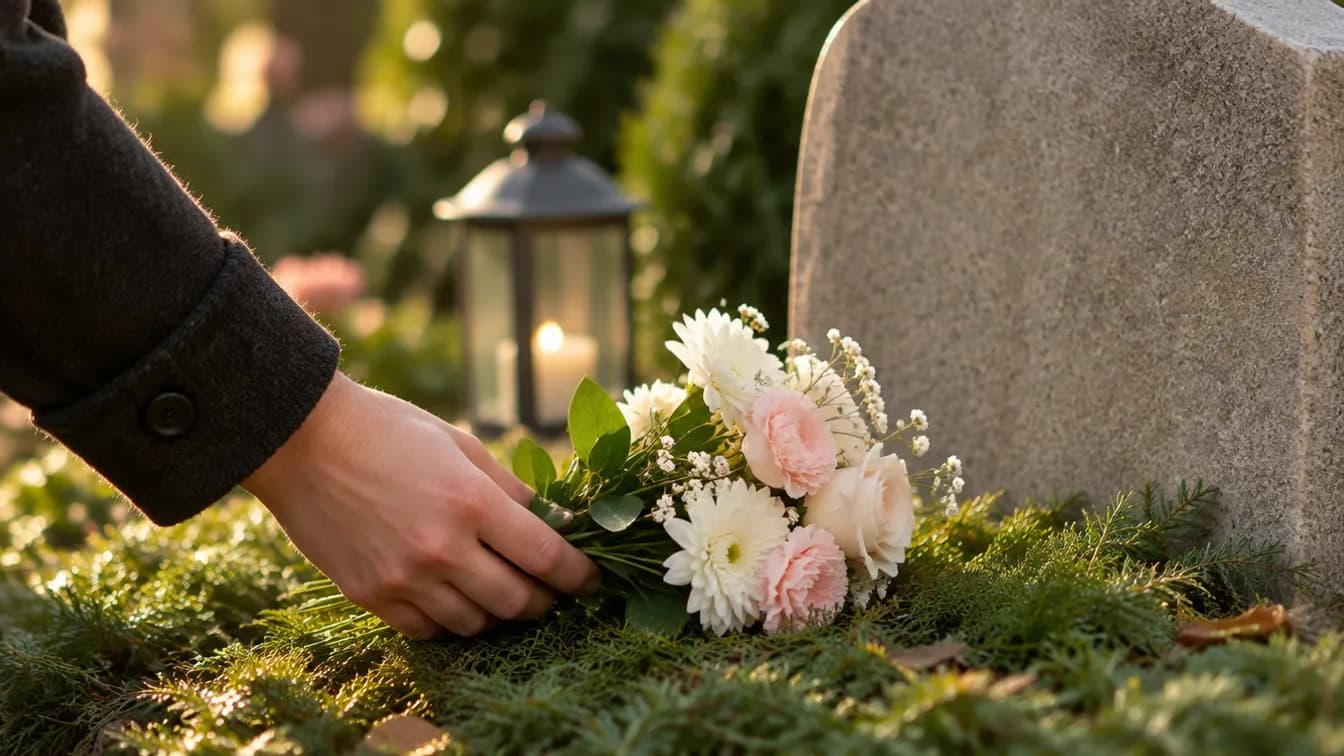
After the funeral, the wreaths and arrangements from the service lie on the fresh grave mound. They stay as long as they look presentable. Depending on the weather, that is usually two to six weeks – less in summer, more in winter.
When the flowers fade, the wreaths and arrangements are cleared away. Many cemetery rules require this explicitly. Pay attention to separating the waste: flowers and greenery go into the green waste, ribbons, wire, plastic and floral foam into the general waste. Many relatives keep the ribbons with the dedications as a memento.
During this time you can already decorate the grave with fresh cut flowers in a vase or a small plant bowl. For a coffin grave, however, you should not yet plant anything in the soil.
Why the soil needs time
In an earth burial, the grave is filled with loose soil after the burial and heaped into a mound. Over the following months this soil sinks, through rain, frost and its own weight. Only then is the area firm enough for a headstone to stand safely and for plants not to sink with the soil.
How long this takes depends on the soil, the weather and the season. It is usually three to six months, longer with heavy soils. If you plant permanently too early, you often have to redo the work: the plants then stand in a hollow, or they are damaged when the stone is set.
With an urn burial, things are different. The pit is small and the soil barely settles. An urn grave can therefore be planted permanently after just a few weeks.
Timeline: from grave mound to finished grave
For an earth grave with a coffin, the following sequence has proved its worth. The times are guidelines and depend on the cemetery and the weather.
| When | What is due |
|---|---|
| Day of the funeral | Grave mound with wreaths and arrangements, wooden cross or name plaque |
| after 2 – 6 weeks | Clear away faded wreaths, tidy the grave mound |
| up to about 3 months | Interim planting or a plant bowl, keep the grave tidy |
| after 3 – 6 months | The soil has settled; level the area and top it up |
| after about 6 – 12 months | Have the headstone set, then the permanent planting |
Many families plan the headstone and the planting together. This has an advantage: the colour and shape of the stone and the plants can be matched to each other.
The interim planting
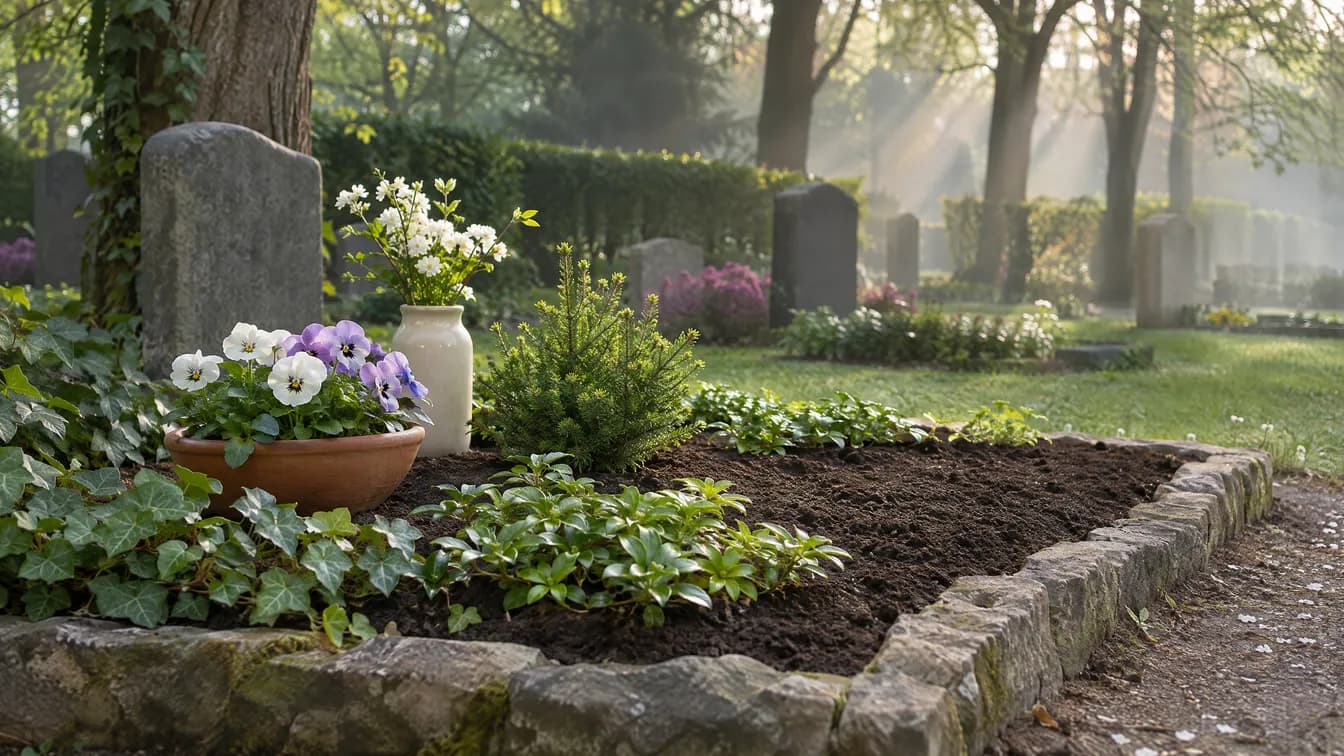
Until the soil has settled, the grave should still look cared for. Simple interim planting is enough for this:
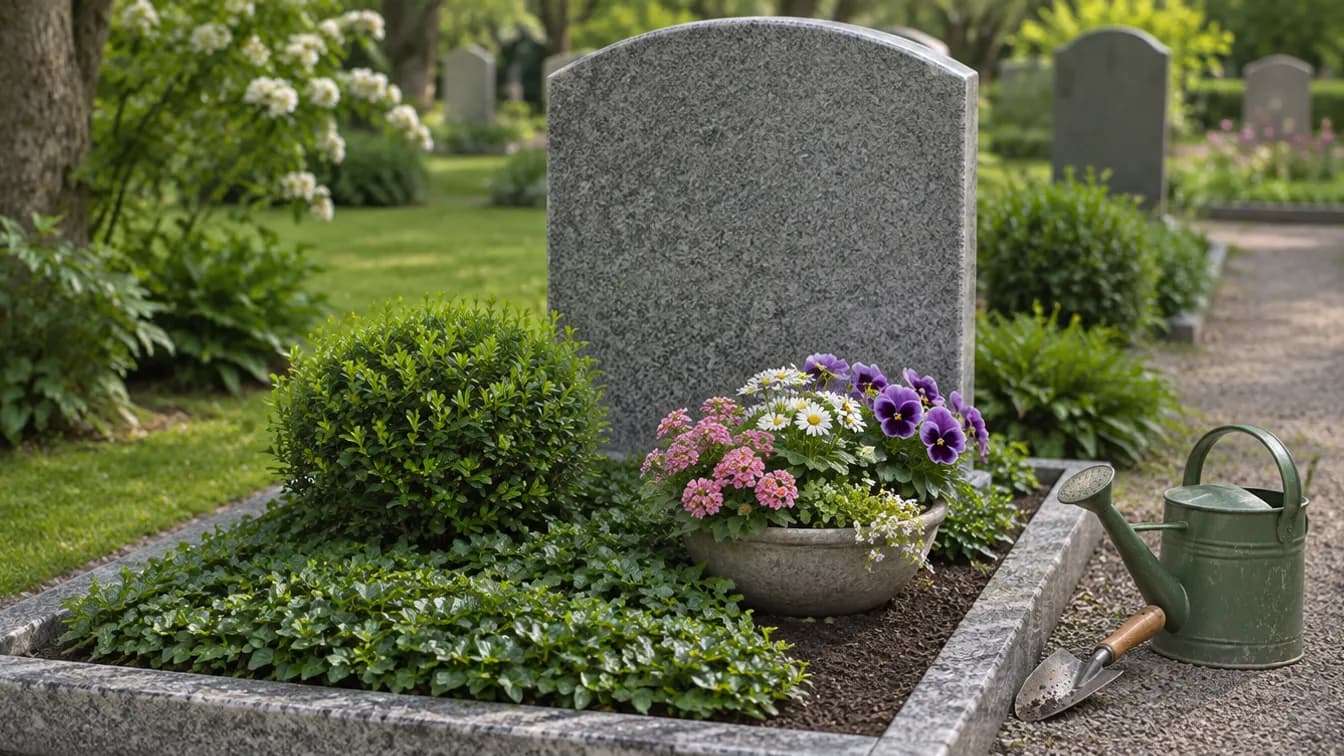
- Seasonal flowers in small numbers, for example pansies in spring, begonias in summer or heather in autumn.
- A plant bowl on the grave mound. It is easy to move when the mound is levelled or the stone is set.
- Fir greenery in winter. It covers the soil and protects against frost.
Water the plants regularly in the first weeks, because the loose soil of the grave mound dries out quickly. If weeds grow, pull them early before they take hold.
The permanent planting
Once the headstone is in place, the grave can be designed for the long term. A division into three areas has proved its worth:
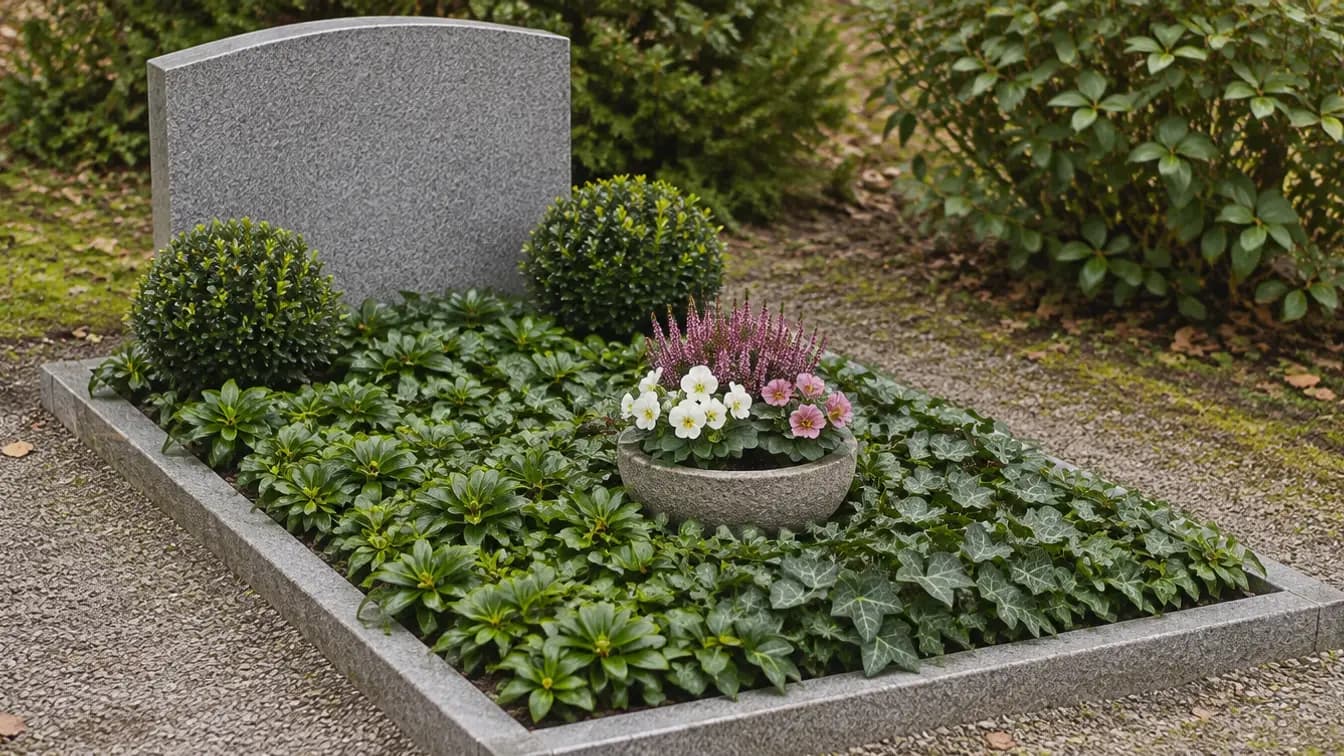
- Frame: low, evergreen ground cover plants such as ivy, wintercreeper or pachysandra, which close the surface and suppress weeds.
- Structure: one or two small shrubs, for example a dwarf conifer or a Japanese holly.
- Seasonal area: a small area or plant bowl for seasonal flowers that you renew two or three times a year.
Before planting, the area is levelled, topped up with fresh grave soil (Graberde) and loosened. Plan the planting according to how often you come to the cemetery yourself. If you are rarely there, choose low-maintenance plants and a small seasonal area. You can read which plants are suitable in the article Low-maintenance planting for a grave.
The best times for the permanent planting are spring and autumn. In high summer, freshly set plants need a great deal of water; in winter they do not take root in frozen soil.
What the cemetery rules require
How a grave may be designed is set out in the cemetery rules (Friedhofssatzung) of your municipality. The cemetery administration (Friedhofsverwaltung) will give them to you on request, and they are often on the town’s website. Common rules include:
- Deadline for the layout: many rules require the grave to be put in a dignified condition within a certain time after the burial, often within six months.
- Headstone: you usually need approval for its size, material and inscription. The stonemason (Steinmetz) normally takes care of the application.
- Design: some sections have special rules, for example on the height of plants or the share of gravel and grave slabs.
- Plants: trees and rampant plants are often not allowed, because they grow onto paths and neighbouring graves.
The person who holds the right of use for the grave (Nutzungsrecht) is responsible for its layout and care. Who that is is recorded in the grave certificate or held by the cemetery administration.
What the first layout costs
If you plant yourself, you only pay for grave soil, plants and possibly a plant bowl. How much that is depends on the size of the grave and the choice of plants; evergreen ground cover plants cost more to buy but save work and seasonal plants later.
If a cemetery gardener’s business (Friedhofsgärtnerei) does the first layout, guides quote amounts for a single grave from a few hundred to around 1,000 euros. This includes levelling, fresh soil, the basic planting and often a first seasonal planting. Larger graves and elaborate designs cost more. You can find the running costs afterwards in the article What does grave care cost per year?
Ideally, get two or three quotes and have it written down exactly what is included: plants, soil, working time and disposal.
If you cannot be there yourself
Many relatives do not live near the cemetery. Especially after a death, it is a relief when someone on site takes care of the work.
On irespect you describe what needs to be done at the grave – for example clearing away the wreaths, setting interim planting or redesigning the grave after the stone has been set. Grave carers from the region send you offers, you choose one and receive a confirmation photo after the work. One-off grave care starts at €29, seasonal planting at €35 and a complete grave redesign at €89; the grave carers set their own prices. If you would first just like to know what the grave looks like at the moment and whether the soil has settled yet, book a condition check with photos. The article Grave care from a distance explains in detail how this works.
Checklist: the grave after the funeral
- Clear away wreaths and arrangements as soon as they fade, and dispose of them properly
- Tidy the grave mound, check the wooden cross or name plaque
- Set up interim planting or a plant bowl and water it regularly
- Obtain the cemetery rules: deadline, headstone, design
- After three to six months, check whether the soil has settled
- Commission the headstone from a stonemason
- Once the stone is set, lay out the permanent planting
Frequently asked questions
When can a grave be planted after the funeral?
For an earth grave with a coffin, only once the soil has settled. This usually takes three to six months. The permanent planting therefore generally follows about six months after the funeral, often after the headstone has been set. An urn grave, by contrast, can be planted almost straight away.
How long do wreaths and arrangements stay on the grave after the funeral?
As long as they look presentable, usually two to six weeks. Under most cemetery rules (Friedhofssatzung), faded wreaths and flowers must be removed. Ribbons, wire and floral foam do not belong in the green waste.
What goes on the grave until the permanent planting?
Once the wreaths have been cleared, the grave mound is tidied and usually given simple interim planting: a few ground cover plants, seasonal flowers or a plant bowl. A wooden cross or a name plaque marks the grave until the headstone is in place.
What does the first planting of a grave cost?
For the first layout of a single grave, guides quote amounts from a few hundred to around 1,000 euros, depending on size, soil, plants and design. Larger graves or elaborate designs can cost more. On irespect, a grave redesign starts at €89.
Is there a deadline by which the grave must be laid out?
Many cemetery rules require the grave to be put in a dignified condition within a certain time after the burial, often within six months. The exact deadline is set out in the cemetery rules (Friedhofssatzung) of your municipality or available from the cemetery administration (Friedhofsverwaltung).