Contents of this article
A well-kept grave matters deeply to many relatives. But not everyone has the time to travel to the cemetery every week, pull weeds and water. The solution often lies in the planting itself: if you choose the right plants, you have a dignified grave all year round – with considerably less work.
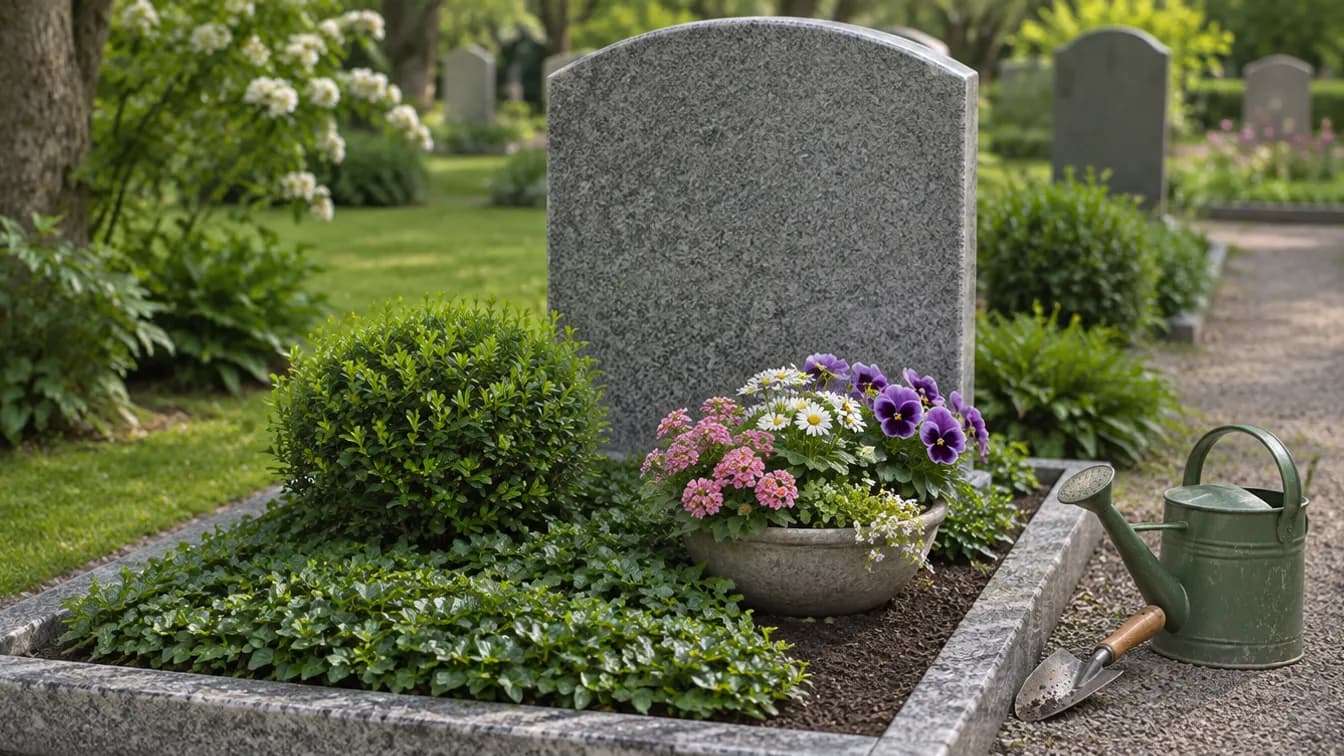
The principle: frame, ground layer, accent
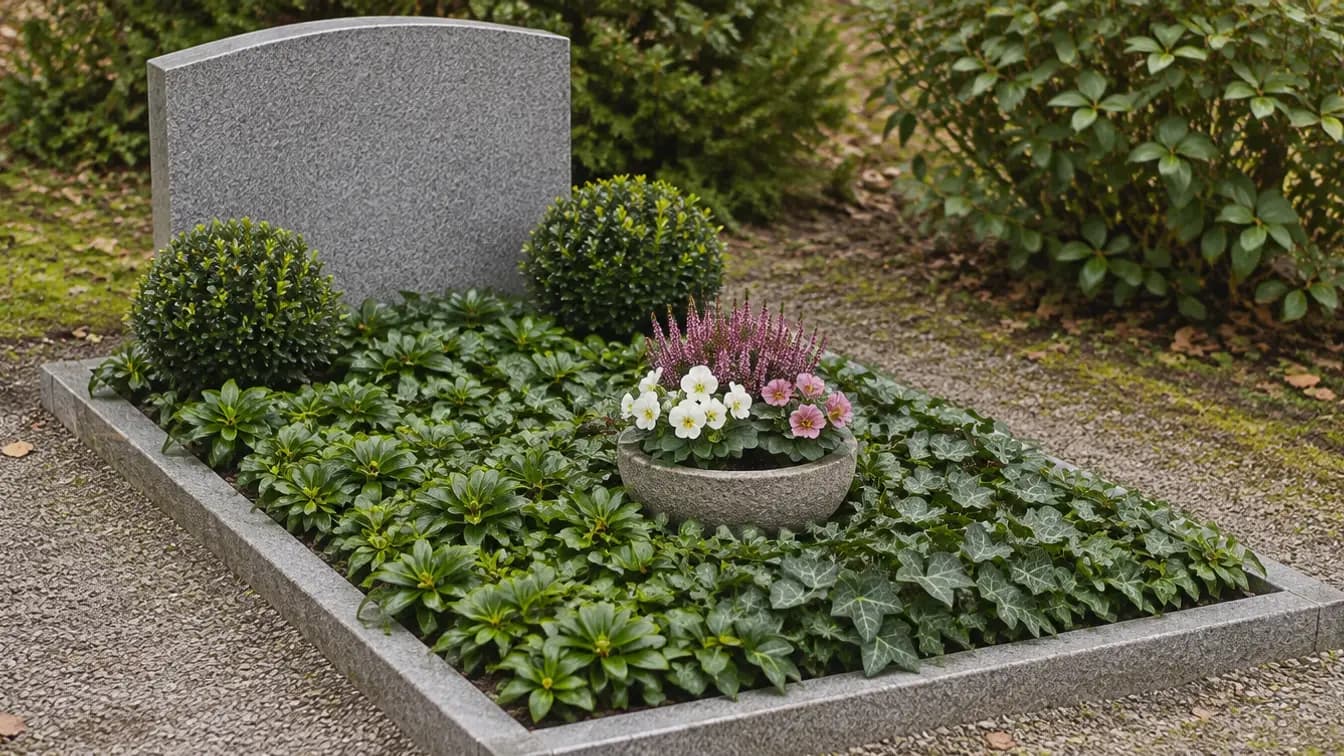
A design on three levels has proved its worth:
- The frame: one or two small evergreen shrubs that give the grave structure – usually at the head of the grave next to the gravestone.
- The ground layer: a dense carpet of ground cover plants that covers most of the planting area.
- The accent: a small area or bowl for changing flowers, which you replant according to the season.
The advantage: the frame and the ground layer remain in place for years. Only the small accent area needs regular attention. In this way the grave always looks cared for, and the effort stays manageable.
Ground cover plants: the foundation
Ground cover plants are the most important building block of a low-maintenance grave. They close over the area, suppress weeds and keep moisture in the soil. Which plants are suitable depends above all on the light.
For shade and partial shade:
- Ivy (Hedera helix): robust, evergreen, grows even under trees. Needs cutting back occasionally so that it does not spread over the surround.
- Pachysandra or Japanese spurge (Pachysandra terminalis): dense, glossy leaves, very easy to care for.
- Lesser periwinkle (Vinca minor): with blue flowers in spring.
- Barren strawberry (Waldsteinia ternata): yellow flowers, keeps its leaves in winter.
For sun:
- Wintercreeper (Euonymus fortunei): in green and variegated varieties, very adaptable.
- Creeping thyme: fragrant, tolerates drought.
- Stonecrop (Sedum): stores water in its leaves, ideal for hot locations.
- Moss phlox: forms bright cushions of flowers in spring.
Plant ground cover plants in sufficient numbers – depending on the species, about eight to twelve plants per square metre. Plants set too far apart take a long time to close over the area, and in the meantime weeds grow.
Small shrubs for structure
A grave looks calmer and more refined when it has a firm frame. Slow-growing shrubs that tolerate pruning are suitable:
- Japanese holly (Ilex crenata): looks like box but is less susceptible to diseases and pests.
- Dwarf pines and small junipers: robust and tolerant of sun.
- Dwarf false cypresses: in green, gold or blue-grey.
- Compact rhododendrons or azaleas: for graves in partial shade with acidic soil.
Box was for a long time the standard plant in the cemetery, but in many places it is damaged by the box tree moth and by fungal diseases. If you are planting anew, you are better advised to choose the alternatives named above.
The right soil
Good soil is the precondition for the plants to take root and spread. Many cemetery soils are compacted or exhausted after decades of use. Before replanting, it is therefore worth loosening the soil to a spade’s depth and improving it with fresh planting compost.
Dark grave soil (Graberde) is customary as a covering between the plants. It makes the grave look tidy and keeps moisture in the soil. Look for peat-free or reduced-peat products – this protects peat bogs and with them the climate.
Seasonal planting: little space, great effect
A low-maintenance grave may flower too. Depending on the season, the following are suitable for the accent area:
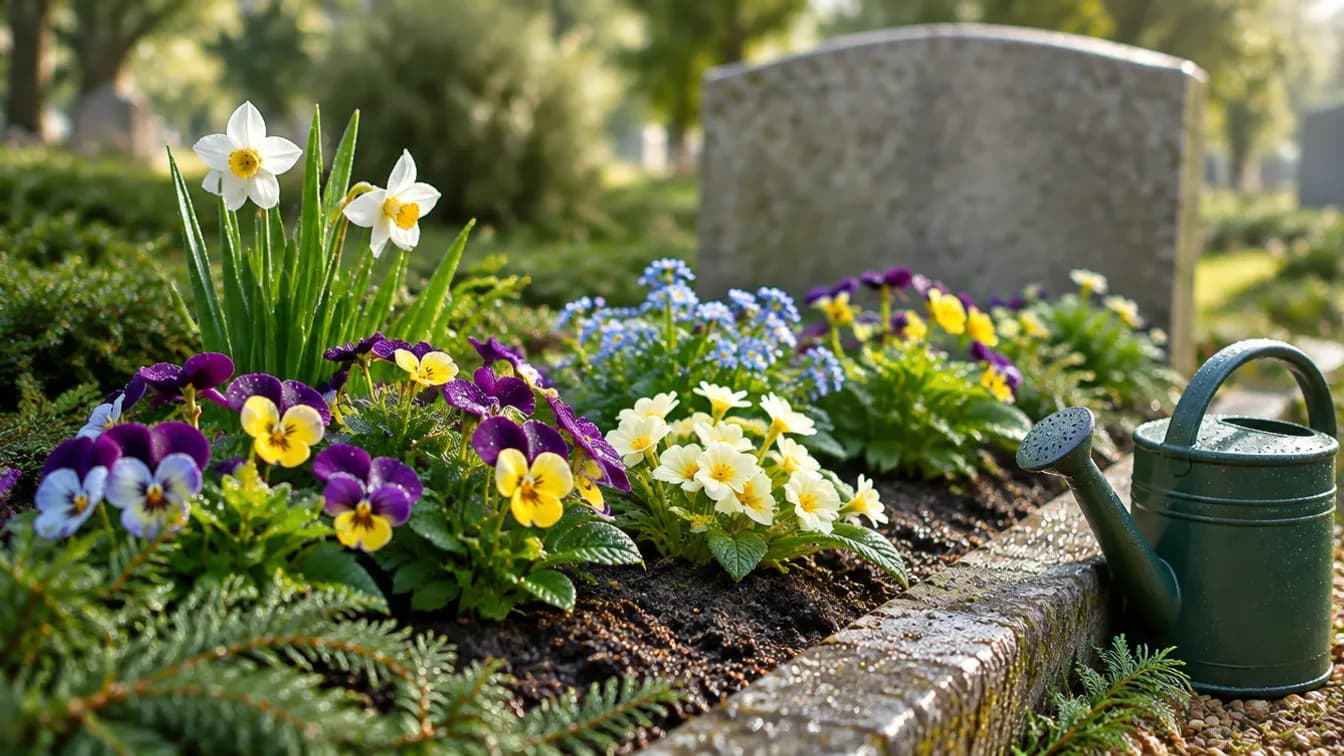
- Spring: pansies, violas, primroses, forget-me-nots, daffodils
- Summer: begonias, busy Lizzie, wax begonias, lavender
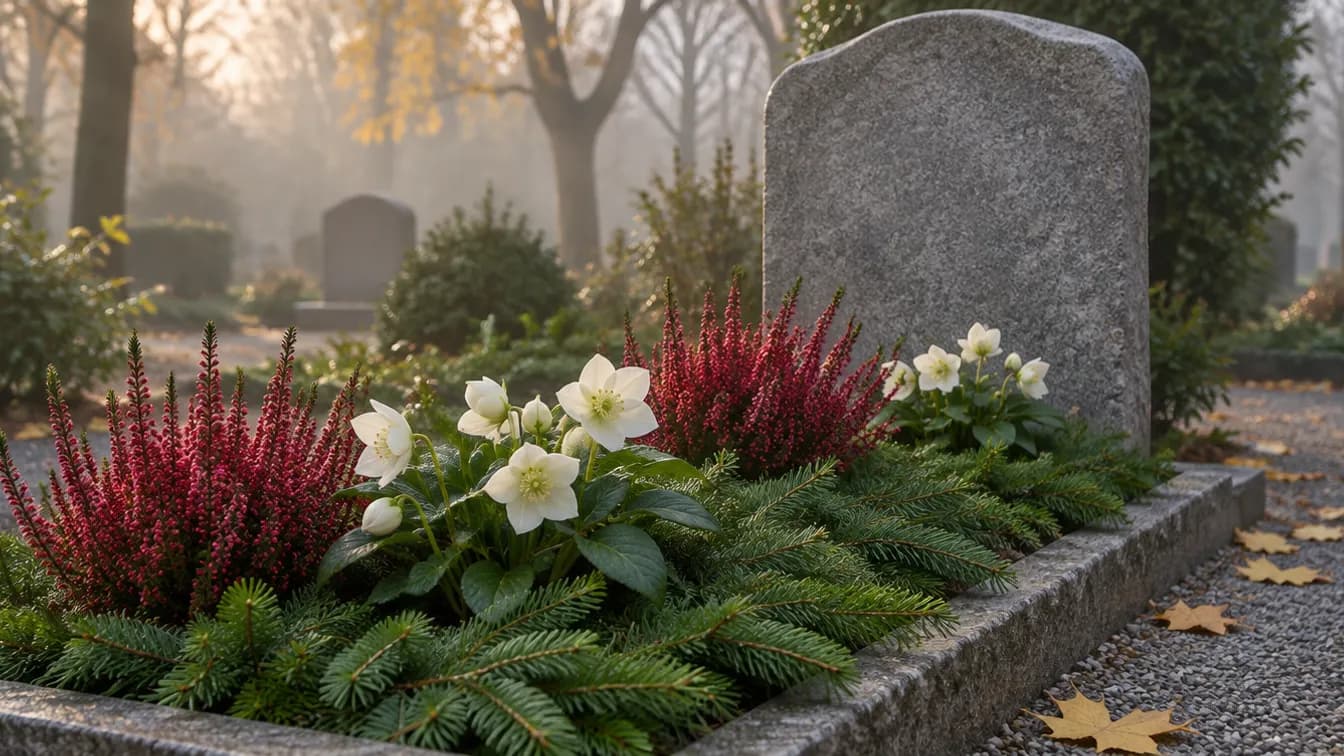
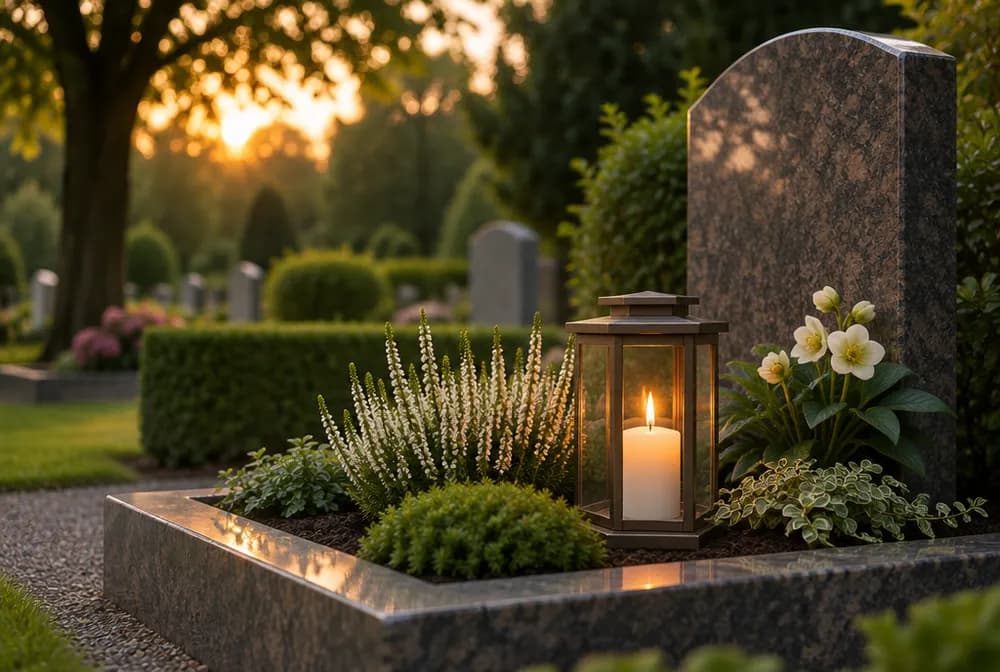
- Autumn and winter: heather, Christmas roses, coral bells, wintergreen
A planted bowl instead of a planting area makes the change even easier. You can read more about spring and summer plants in the article Grave care in spring and summer, and about winter planting in the article Preparing a grave for winter.
A special case: the urn grave
Urn graves are considerably smaller than graves for coffin burials, often only one square metre in size. Here even a little planting looks full. A single small shrub, a carpet of one species of ground cover plant and a planted bowl are usually enough. Too many different plants quickly make the small area look cluttered. Choose particularly slow-growing species so that the gravestone or grave slab remains clearly visible.
What you should avoid
- Vigorously spreading plants such as certain ivy varieties that are not cut back, or bamboo: They grow onto neighbouring graves and paths.
- Shrubs that grow too large: What is small today can hide the gravestone in ten years. Check the eventual size.
- Plastic sheeting under gravel: Many cemeteries prohibit it because the soil beneath cannot breathe.
- Artificial flowers in large quantities: They fade in the sun and quickly look untidy. Some cemetery regulations restrict them.
Whether gravel, bark mulch or stone slabs are permitted, and how much of the area must be planted, is laid down in the cemetery regulations (Friedhofssatzung). A short call to the cemetery administration before the redesign saves trouble.
The care required after the changeover
In the first year after replanting, the plants still need some support: regular watering in dry weather and the removal of weeds between the ground cover plants. From the second year, the effort falls considerably. Then the following is usually enough:
- cutting back the ground cover plants and shrubs in spring
- occasional weeding
- watering in longer dry periods
- removing leaves in autumn
- changing the accent planting two to three times a year
Having the redesign done for you
Changing over to low-maintenance planting is a one-off job that pays off for years. If you do not have the time or strength for it yourself, you can hand the work over. On irespect you can order a permanent planting with evergreen plants or a complete redesign of the grave. In your order, describe your wishes regarding plants and colours and state whether the grave is mainly in sun or in shade. Grave carers from the area send offers, and once the work is done you receive photos documenting the work.
Conclusion
A low-maintenance grave is not a sign of neglect but of sensible planning. With a carpet of ground cover plants, a frame of small shrubs and a place for seasonal flowers, the grave plot stays dignified all year round – and the care required falls to a few visits a year. The article What does grave care cost per year? shows what this saves in the long term.
Frequently asked questions
Which ground cover plants are suitable for a shady grave?
In shade under trees, ivy, pachysandra, lesser periwinkle (Vinca minor) and barren strawberry grow reliably. They form dense, evergreen carpets and manage with little light.
Which plants are suitable for a sunny grave?
In full sun, wintercreeper, creeping thyme, moss phlox, stonecrop and compact grasses have proved their worth. They tolerate drought better than classic shade plants.
Is it permitted to design a grave with gravel or stones?
That is laid down in the cemetery regulations. Many cemeteries in Germany limit the proportion of the area that is not planted, or prohibit plastic sheeting and large gravel beds. Ask the cemetery administration before redesigning the grave.
How long does it take for ground cover plants to close over the area?
Depending on the species and the planting distance, usually one to two growing seasons. During this time you should remove weeds regularly and water in dry weather so that the plants spread well.