Contents of this article
- The right time
- Step 1: Remove leaves and summer plants
- Step 2: Prepare the soil
- Step 3: Put in hardy plants
- Step 4: Cover with fir branches
- Step 5: Do not forget to water
- Step 6: Check the gravestone and surround
- Arrangements and grave candles for the days of remembrance
- If you cannot be there yourself
- Checklist: preparing a grave for winter
The best time to prepare a grave for winter is from the end of October to mid-November, before the first lasting frost. By then most of the leaves have fallen and the summer flowers have faded, and with All Saints’ Day (Allerheiligen) and the Sunday of the Dead (Totensonntag) the days of remembrance are approaching on which many relatives in Germany visit the graves of their dead.
The good news: a grave does not need much to be ready for winter. With a few jobs done in autumn, the grave plot stays tidy until spring – even if you can rarely be there in person.
The right time
Most cemetery gardeners begin winter planting at the end of October. The ideal date is after the surrounding trees have lost most of their leaves, but before the ground freezes for good. In many regions of Germany this is the period between All Saints’ Day (1 November) and the Sunday of the Dead, which falls on 22 November in 2026.
Planting earlier has the advantage that the plants can still put down roots. If you come later, hardly any more leaves will fall on the grave. Either is fine – all that matters is that the work is done before the first hard frost.
Running late? A grave can still be prepared for winter in December, as long as the ground is not frozen. Removing leaves and covering the grave with branches can be done even in a light frost. New plants, on the other hand, should not go in until the ground has thawed again. Until then, a planted bowl or an arrangement of fir greenery will keep the grave looking cared for.
Step 1: Remove leaves and summer plants
Damp leaves lying on the grave for weeks deprive the plants of light and air. Underneath, ground cover plants begin to rot, and on light-coloured gravestones and surrounds the leaves leave brown stains. That is why thorough removal of the leaves comes first.
This is how to go about it:
- Remove leaves from the planted area, the paths and the surround with a narrow rake or by hand.
- Take out faded summer flowers such as begonias or busy Lizzies together with their root balls.
- Cut back dead shoots on perennials, but do not cut ground cover plants back drastically.
- Take green waste to the containers the cemetery provides for it, observing the separation into compost and general waste.
For graves under large trees, one round is often not enough. Here it is worth going over the grave again in November and December.
Step 2: Prepare the soil
After clearing, the soil is carefully loosened and freed of weeds. If the planted area has sunk, top it up with a little fresh grave soil (Graberde). This dark, fine, crumbly soil holds moisture well and makes the grave look cared for. Peat-free mixes are the better choice today.
A light fertiliser is not needed in autumn. The plants should now ripen their growth, not put on any more soft shoots.
Step 3: Put in hardy plants
For the cold season, plants that tolerate frost and still bring colour have proved their worth:
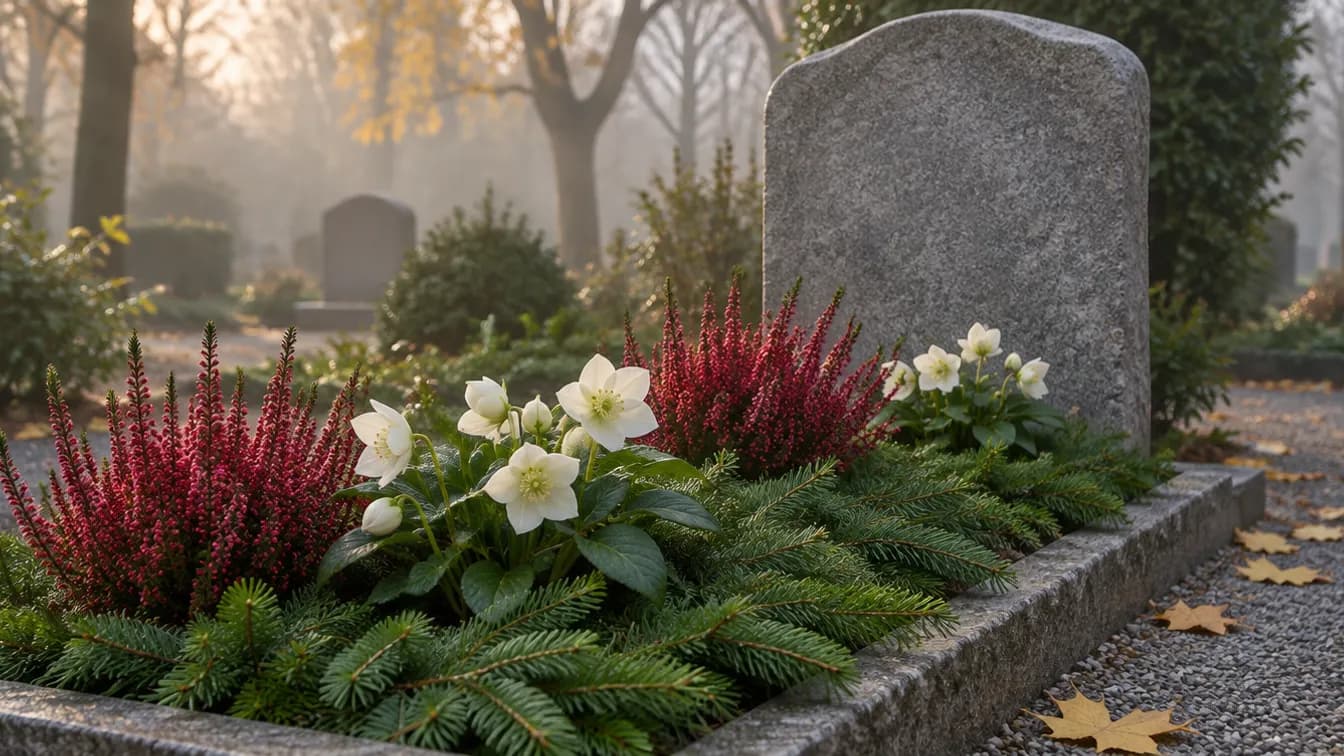
- Christmas rose (Helleborus niger): flowers from December to February depending on the weather and is regarded as the classic grave plant for winter.
- Winter heath (Erica carnea): flowers in white, pink or red into spring.
- Wintergreen (Gaultheria): small red berries that last a long time.
- Coral bells (Heuchera): striking leaves in red, bronze or silvery green.
- Japanese sedge (Carex morrowii) and other grasses that stay green in winter: add structure and remain presentable even in grey weather.
- Dwarf conifers or small alternatives to box such as Japanese holly (Ilex crenata).
Make sure the plants are not too close together. Between the root balls there should be a little room left for fir greenery and decoration.
Step 4: Cover with fir branches
Covering a grave with branches of fir, spruce or pine has a long tradition. In German, many people say “eindecken” instead of “abdecken” for this – it means the same thing. The covering has a practical purpose: the branches protect perennials and ground cover plants from bare frost, that is, frost without a protective blanket of snow, and from the low winter sun, which dries out frozen plants. At the same time, the greenery keeps the grave looking cared for well into March.
The branches are laid in overlapping layers from the outside inwards, so that the cut ends are hidden. Nordmann fir keeps its needles longest. Spruce branches are cheaper, but shed their needles more quickly.
Step 5: Do not forget to water
Many relatives assume that there is no need to water in winter. That is only partly true. Evergreen plants lose water through their leaves in the cold season too. If the ground is frozen, the roots cannot replace it, and the plants dry out. On frost-free, dry days you should therefore water thoroughly, especially after longer cold spells.
Step 6: Check the gravestone and surround
Autumn is a good occasion to take a careful look at the gravestone. Water that gets into cracks and joints can split the stone when it freezes. Moss and algae can be removed before winter with warm water and a soft brush. You can read more in the article How to clean a gravestone and refresh the inscription.
If the stone is loose, you should report this to the cemetery administration (Friedhofsverwaltung). As a rule, the person who holds the right of use for the grave is responsible for the stone’s stability.
Arrangements and grave candles for the days of remembrance
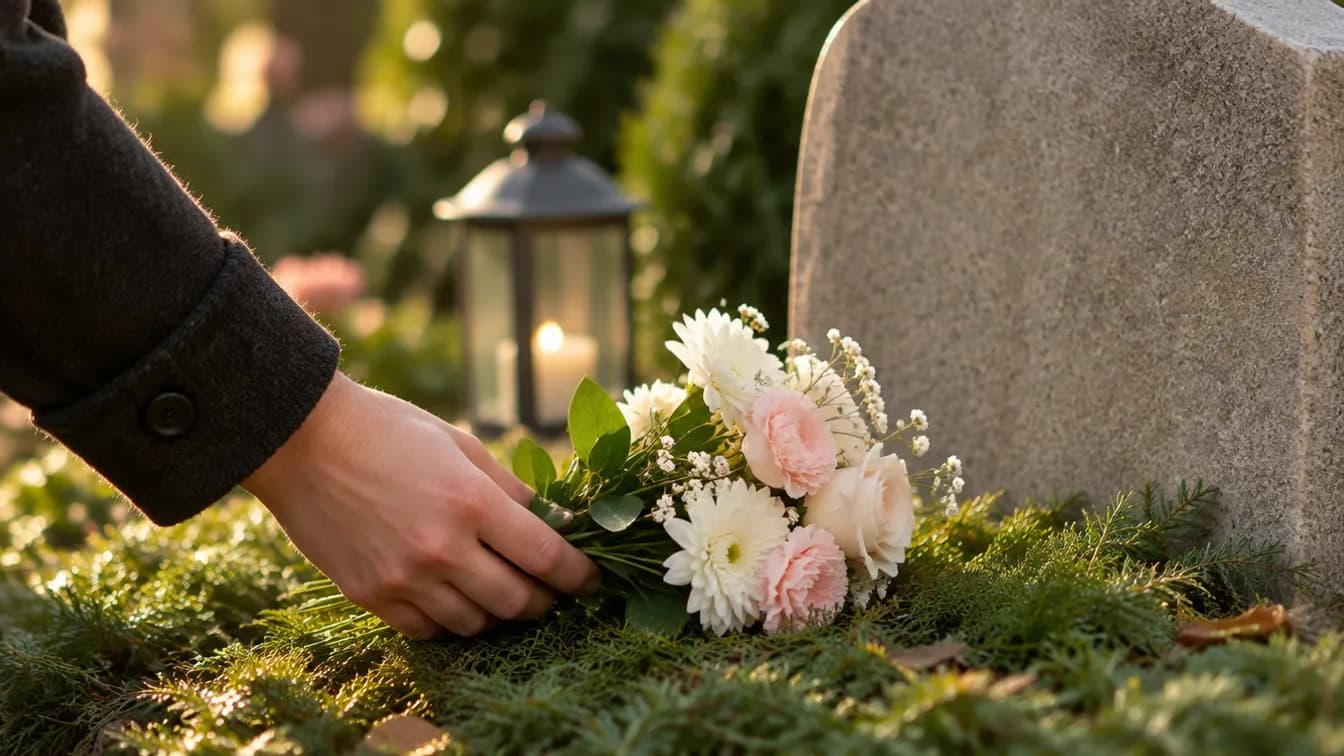
On All Saints’ Day, the Sunday of the Dead and at Christmas, many relatives decorate the grave with particular care. Arrangements of fir greenery, cones, moss and dried materials are popular, complemented by a grave candle. Choose weatherproof materials and avoid plastic and floral foam where possible, as many cemeteries now ask visitors to avoid waste. Exactly what is permitted is laid down in the cemetery regulations (Friedhofssatzung) of your municipality.
Grave candles should stand securely and not be placed right next to dry branches. Take the empty candle cases away with you on your next visit.
If you cannot be there yourself
Not everyone lives near the cemetery. In autumn especially, when paths are wet and days are short, the visit is also arduous for older relatives. Then someone else can take on the work.
On irespect, you describe what needs to be done at the grave – for example leaf removal, winter planting and an arrangement for the Sunday of the Dead. Grave carers from the area send you offers; you make your choice and receive a confirmation photo after the work. That way you see that everything has been done, even if you live hundreds of kilometres away. The grave carers set the prices themselves; winter planting is available from €35. How this works in detail is described in the article Grave care from a distance.
Checklist: preparing a grave for winter
- Remove leaves and faded summer plants
- Weed, loosen the soil, top up with grave soil if necessary
- Put in hardy plants
- Cover with fir or spruce branches
- Water on frost-free days
- Check the gravestone for cracks, moss and stability
- Put out an arrangement and a grave candle for the days of remembrance
With these steps, the grave plot remains dignified until spring. In March the branches are then removed and room is made for the spring planting. How to go about this is described in the article Grave care in spring and summer.
Frequently asked questions
When should a grave be prepared for winter?
Ideally between the end of October and mid-November, after most of the leaves have fallen and before the first lasting frost arrives. Many people combine the work with a visit on All Saints’ Day or before the Sunday of the Dead.
Does a grave have to be covered in winter?
A covering of fir or spruce branches is not compulsory, but it protects perennials and ground cover plants from frost without snow cover and from the winter sun. At the same time it keeps the grave looking cared for over several months. In German cemeteries this is also referred to as “eindecken”.
How do you cover a grave properly in winter?
First remove leaves and faded summer plants, loosen the soil and water it. Then lay branches of fir, spruce or pine in overlapping layers from the outside inwards, so that the cut ends are hidden. Nordmann fir sheds the fewest needles. The branches are removed again in March.
Which plants last through the winter on a grave?
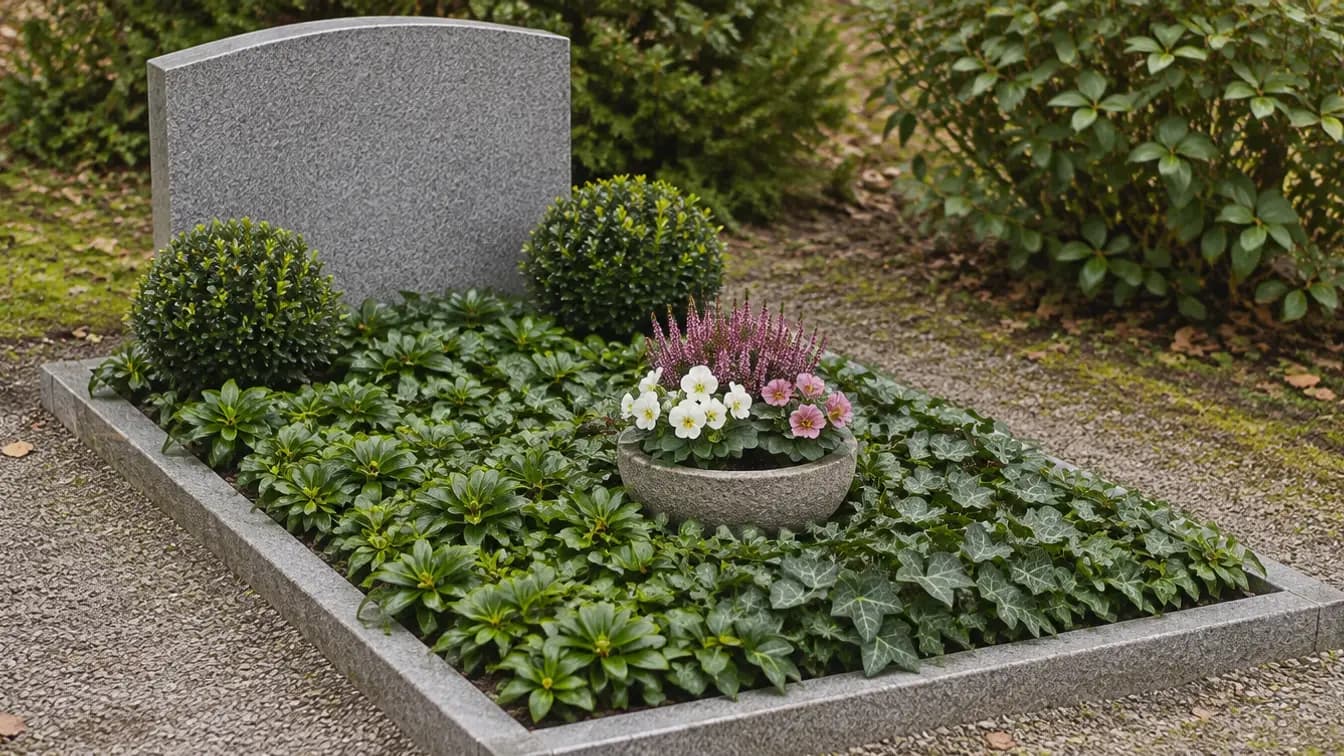
Christmas roses, winter heath, wintergreen, coral bells, Japanese sedge and small conifers have proved their worth. Evergreen ground cover plants such as ivy, wintercreeper or pachysandra are suitable as a permanent base.
Does a grave have to be watered in winter?
Yes, on frost-free, dry days. Evergreen plants lose water through their leaves in winter too. If the ground is frozen for a long time, they can dry out even though there is snow on the ground.