Contents of this article
Christmas grave decorations usually go into the cemetery around the first Sunday of Advent – in 2026 that is 29 November, one week after the Sunday of the Dead (Totensonntag). They stay until after Epiphany on 6 January, and in some families traditionally until Candlemas on 2 February. In between, Christmas Eve is the most important day of the year for many relatives to visit the grave.
There are no fixed rules about the timing. What may be placed on the grave, however, is set out in the cemetery rules (Friedhofssatzung) of your municipality. This article helps you plan both.
When the Christmas decorations go on the grave
Many relatives follow the church year when decorating a grave. Until the Sunday of the Dead, arrangements in muted colours lie on the grave. Then Advent begins, and with it things may turn festive: red accents, cones, stars or a small wreath.
Three dates have proved their worth:
- Straight after the Sunday of the Dead: if you are preparing the grave for the days of remembrance anyway, you swap the arrangement for the Christmas decorations a week later.
- On the first Sunday of Advent: the most common time. The grave is then decorated throughout December.
- In the week before Christmas Eve: the arrangement is still quite fresh over the holidays. This is especially worthwhile in mild weather, when fir greenery fades faster.
Before you lay the arrangement, the grave should be cleared and prepared for winter. You can read how to do this in the article Preparing a grave for winter.
Which grave decorations are suitable
In the cemetery, decorations have to withstand wind, rain, frost and sometimes snow. These have proved their worth:
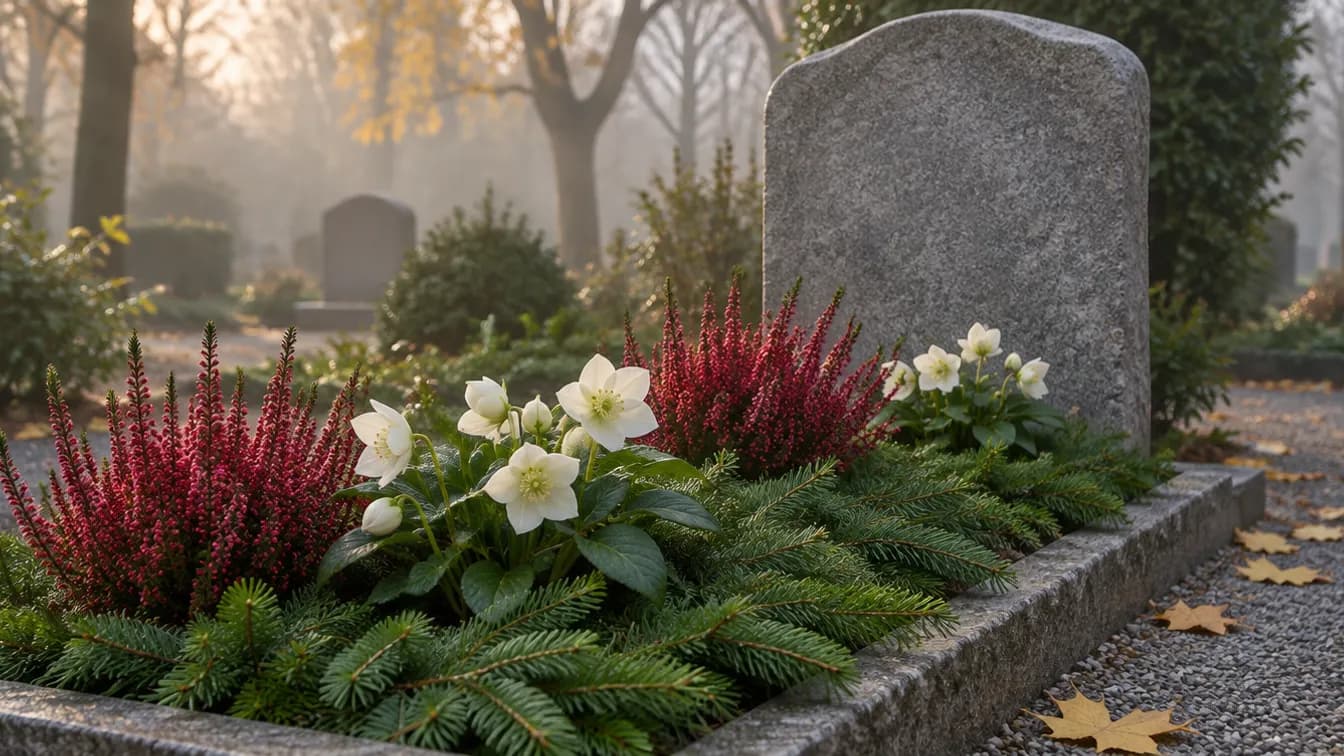
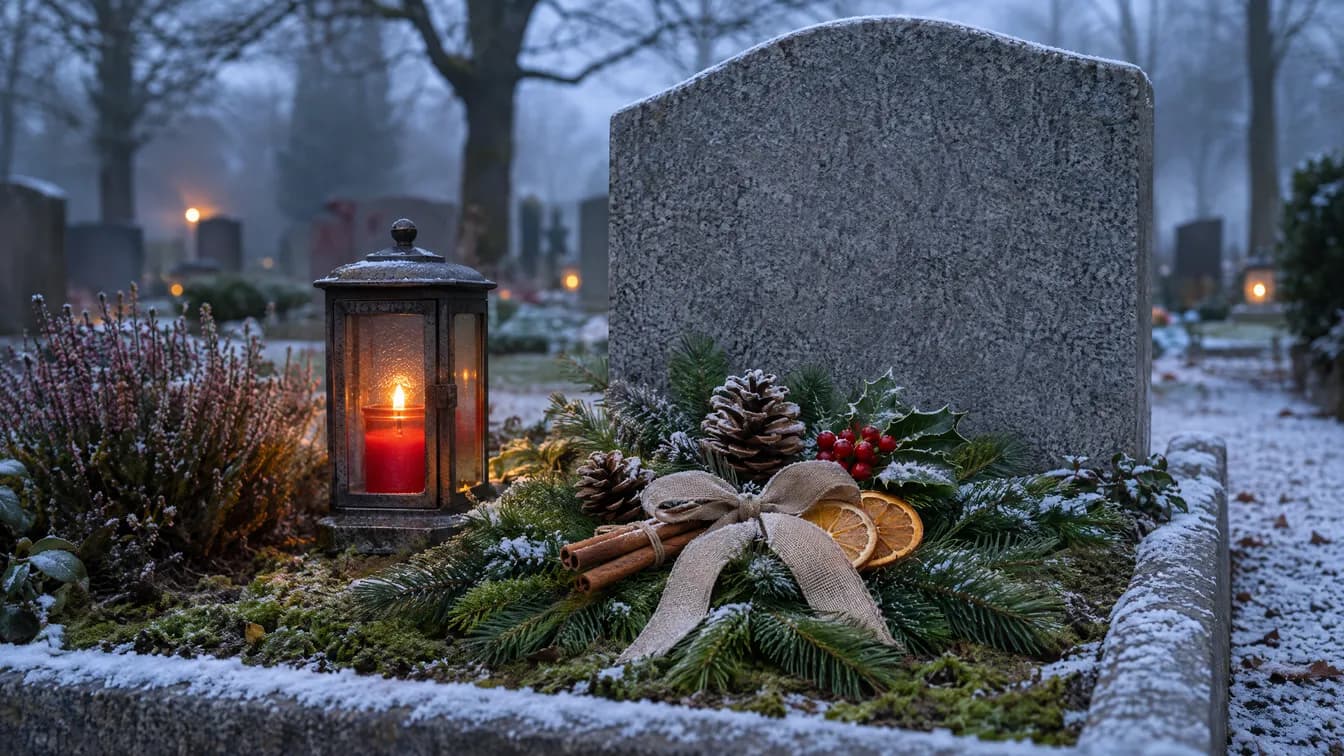
- Grave arrangement: a flat arrangement of fir greenery on a base, finished with cones, berries, cinnamon sticks, dried orange slices or ribbons. It lies on the planting area or stands in front of the headstone.
- Grave wreath: a wreath of brushwood, usually laid flat. It looks simple and lasts a long time.
- Plant bowl: a bowl with a Christmas rose, wintergreen or a small conifer. It stays attractive through the winter and can be planted into the grave later.
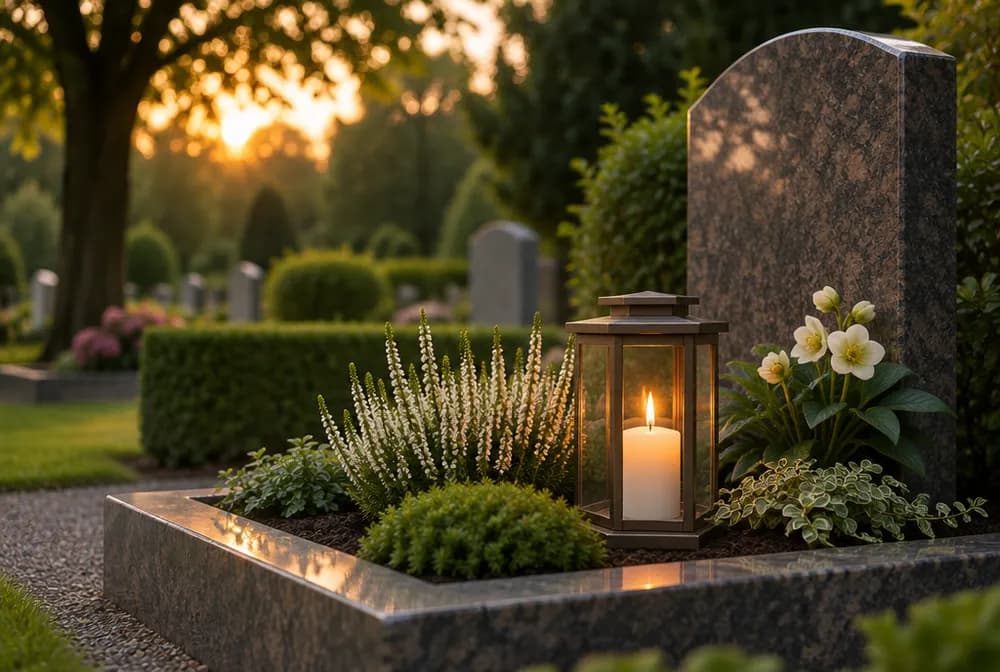
- Grave light: a light in a lantern or holder, often the only sign that can also be seen in the dark.
Nordmann fir, pine, cypress and thuja are good for the greenery, because they keep their needles for a long time. Holly with red berries and mistletoe add festive accents. Shiny baubles and glitter look lovely in the shop, but in the cemetery they quickly look untidy after the first rain. Less is usually more.
How long a grave arrangement lasts
An arrangement of fresh fir greenery lasts four to eight weeks in cool, damp weather. Frost does it little harm. Mild, sunny days and a dry easterly wind take a greater toll, because the branches then dry out and start to shed their needles.
How to make your arrangement last longer:
- Buy or make it as fresh as possible and keep it in a cool, shady place until you lay it.
- Choose a spot where it does not lie in the full midday sun.
- Place it on the soil and not on the stone: the greenery gets moisture from below.
- After a storm, remove fallen twigs and straighten cones and ribbons.
If you cannot visit the cemetery regularly, expect an arrangement that looks good until early January. For the time after that, a plant bowl is the more durable choice.
What is allowed in the cemetery
Most cemeteries have rules (Friedhofssatzung) that also cover grave decorations. You can find them on the municipality’s website or obtain them from the cemetery administration (Friedhofsverwaltung). The following often applies:
- Floral foam and plastic: many cemeteries ban floral foam, plastic film, artificial flowers or wire in grave decorations, or ask people to avoid them. The reason: these materials do not rot and have to be separated from green waste at great effort. Bases made of straw, moss, brushwood or willow are fine.
- Size: decorations should stay on your own grave and not reach onto paths or neighbouring graves.
- Clearing away: faded decorations must be removed within a reasonable time. If they stay too long, the cemetery administration may have them cleared.
- Disposal: greenery goes into the green waste, candle holders, wire and ribbons into the general waste. Many cemeteries have separate bins for this.
For urn graves and communal grave areas the rules are often stricter. Sometimes decorations are only allowed at a shared place for flowers. If in doubt, ask the cemetery administration before you buy anything.
Setting up grave lights safely
For many relatives a grave light is part of Christmas. To make sure it burns safely, keep the following in mind:
- Use a closed grave lantern or a grave light with a lid. This protects the flame from wind and rain.
- Place the light on firm ground and away from dry branches and ribbons.
- Depending on its size, a grave light burns from just over a day to about a week. For Christmas Eve, a light that you light on the day itself is enough.
- Battery-powered lights with a timer burn for weeks and are an alternative where open flames are not wanted.
Take empty holders with you on your next visit.
When the decorations come off again
After the holidays, Christmas decorations usually stay until Epiphany on 6 January. In predominantly Catholic regions, Candlemas on 2 February is also a fixed date on which the last Christmas decorations traditionally disappear.
The condition matters far more than the date: if the arrangement is brown, soaked or battered by the wind, remove it sooner. The covering of fir branches, on the other hand, stays until March, because it protects the plants from frost.
If you cannot come yourself at Christmas
Especially over the holidays, many relatives live far away or are with their own families. Someone else can then take care of the grave decorations.
On irespect you describe what you would like – for example an arrangement of fir greenery for the first Sunday of Advent and a grave light on Christmas Eve. Grave carers from the region send you offers, you choose one and receive a confirmation photo after the work. The grave carers set their own prices; holiday decoration starts at €25. If you would like to see after the holidays whether everything is still in order, you can book a condition check with photos. The article Grave care from a distance explains in detail how this works.
Checklist: Christmas grave decorations
- Clear the grave beforehand and prepare it for winter
- Check the cemetery rules: floral foam, plastic, size
- Lay the arrangement around the first Sunday of Advent, later in mild weather
- Set up the grave light in a lantern or with a lid, away from dry greenery
- Check on the grave after storms and before Christmas Eve
- Clear the decorations after Epiphany or by early February at the latest, and dispose of them properly
Frequently asked questions
When do you place Christmas arrangements on a grave?
The usual time is around the first Sunday of Advent, which in 2026 is 29 November. Many people lay the arrangement straight after the Sunday of the Dead (Totensonntag), others only in the week before Christmas Eve. What matters is that the grave has been cleared and prepared for winter beforehand.
How long does a Christmas arrangement stay on the grave?
As a rule until after Epiphany on 6 January, traditionally until Candlemas on 2 February. If the arrangement turns brown earlier, is battered by a storm or starts to go mouldy, remove it sooner.
How long does a grave arrangement made of fir greenery last?
Four to eight weeks in cool, damp weather. Nordmann fir, pine and cypress last longest; spruce sheds its needles faster. Frost does the greenery little harm; mild, sunny days and dry wind take a greater toll.
Is floral foam allowed in the cemetery?
That is set out in the cemetery rules (Friedhofssatzung). More and more cemeteries ban floral foam and plastic in grave decorations or ask people to avoid them, because they do not rot. Arrangements on a base of straw, moss, brushwood or willow are fine everywhere.
May grave lights burn over Christmas?
Yes, grave lights are part of the custom in most cemeteries. They should stand in a closed grave lantern or a holder with a lid and be kept away from dry branches. Where open flames are not welcome, battery-powered lights are an alternative.